Pokémon 151, and the original Pokédex re-drawn.

 Kanto · 2023
The first Pokémon, drawn by today’s hands.
The same creatures. A different century of looking.
The 151 set takes the original Pokédex — the first creatures most people ever drew from memory — and hands them to contemporary illustrators. That makes it less a new set than a comparison: the same Bulbasaur, Charizard, and Mew, re-staged with modern composition, soft digital light, and a painter’s attention to setting. Alongside the creatures sit the trainer-gallery cards, where a familiar character is framed like a portrait. Read together, the set is a study in re-rendering — how an old subject looks when a new hand, and a new era, draws it again.
Nine cards, one re-drawn Pokédex
9 cards · curated to read 151 as illustration — how familiar creatures are re-drawn, and how a trainer becomes a portrait.

Venusaur ex
2023The thesis in one card. Venusaur sits deep in its own foliage, bulb and leaves pressed close to the frame — a Gen-1 starter re-drawn as botanical portrait.
View card
Charizard ex
2023Not a pose but a place. Charizard banks across a volcanic dusk, small against a fading sky — the most-drawn Pokémon re-staged as landscape rather than spectacle.
View card
Blastoise ex
2023Arita takes the third starter underwater. Light filters down through blue, bubbles rising past a heavy, modelled body — mass and depth, the painter’s old instincts in new water.
View card
Mew ex
2023The mascot reduced to a line. Mew floats as luminous pink contour on a field of gold — re-rendering by subtraction, the figure almost dissolved into light.
View card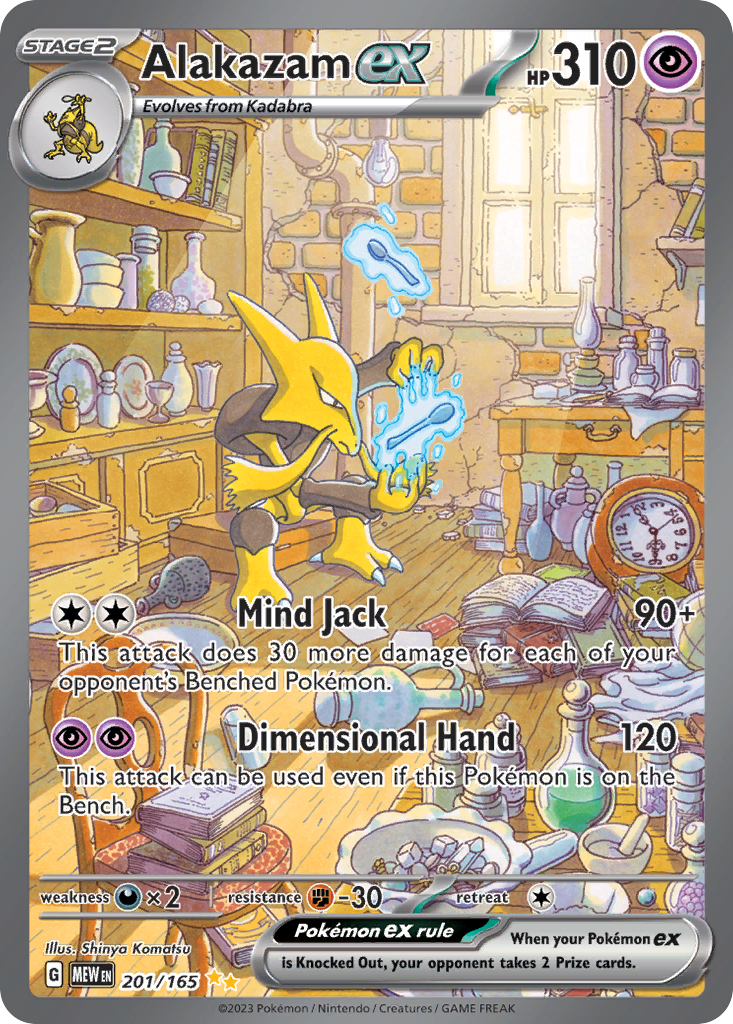
Alakazam ex
2023A creature given a whole room. Alakazam sits among clocks, spoons, and instruments — the psychic re-imagined as an eccentric interior, narrative crowding every corner.
View card
Ninetales ex
2023Re-rendered as ornament. The nine tails fan across a pale ground, the composition closer to a decorative panel than a battle scene — elegance as the whole subject.
View card
Erika’s Invitation
2023Where the set turns to portraiture. Erika stands in a sunlit greenhouse, a small bud in hand — a trainer framed like a painted figure, daylight doing the work.
View card
Giovanni’s Charisma
2023The same idea in a darker key. Giovanni reclines in lamplit shadow, Persian at his side — a character study built from low lamplight and quiet menace.
View card
Daisy’s Help
2023The portrait stepped outdoors. Daisy turns in open wind and pastoral light, hair caught mid-motion — the gentlest of the gallery, all air and soft colour.
View cardHow a set re-renders the familiar
Three things to watch as the original Pokédex is drawn again.
- The creature, re-staged
- The re-drawn Pokémon are rarely floating on a blank field. They are placed — underwater, in a greenhouse, against a dusk sky — so the modern card reads as a scene, not a specimen. Setting carries as much as the subject.
- The trainer as portrait
- The gallery cards treat a character the way a painter treats a sitter: a pose, a light, an interior. Erika among her plants, Giovanni in lamplight — illustration borrowed from portraiture, not the action poses the medium usually reaches for.
- One subject, two eras
- Because every creature here already existed in 1996, each card is implicitly a comparison. The interest is not novelty but re-reading — what a contemporary illustrator keeps, drops, and re-weights when drawing a form everyone already knows.




This guide reads Pokémon 151 as an illustration set — chosen for how each card re-renders a familiar subject through composition, light, setting, and the conventions of modern full-art and trainer-gallery illustration. Cards are selected for visual interest and illustrator range, not for rarity, market value, pull rates, or grade. Selections are refreshed periodically.